CDN: Explained Through Squid Game and Netflix
Q1. Why do we need a CDN?
A CDN delivers data from servers located closer to the user, reducing latency and speeding up websites.
Q2. How does a CDN work?
It stores (or caches) content on multiple regional “POP servers,” then serves it from the one nearest to each user.
Q3. What’s the relationship between CDN and Edge Computing?
CDNs have evolved from simply storing files to adding computing capabilities at each POP — allowing real-time processing of images, videos, and other content.
Q4. Can startups use CDNs too?
Yes. You can build your own using public cloud services like AWS CloudFront, or use a fully managed CDN from Weekerp to apply it instantly without development overhead.

After a long day, MJ — a tired Korean guy just trying to relax — comes home and turns on Netflix to watch Squid Game.
But the video keeps stopping and buffering.
Frustrated, he starts thinking.
Why is this so slow? Are they seriously sending the video all the way from the U.S.?
Then, a funny idea hits him.
Wait… what if I just go watch it right next to Netflix HQ? That’s gotta be faster, right?
And just like that, MJ books a flight to California.

After a long flight, MJ finally lands in California.
He checks into an Airbnb right next to Netflix headquarters, ready to stream without a single buffer.
He sits down, opens his laptop, and hits play.
But… it’s still buffering.
Even worse — it somehow feels slower.
Confused and a little desperate, he calls his friend who works in IT.
MJ: “Dude, I’m literally in the U.S. now, but the video’s still lagging!”
Friend: “That’s because Netflix already sends the video from a server near you. You didn’t need to come all the way here!”
MJ: “…Wait, what??”

MJ sits there in silence, staring at the loading circle spinning on his screen.
He just spent hours on a plane, took days off work, and even got a few missed calls from his wife.
And then it finally hits him.
Netflix was never sending videos all the way from the U.S. in the first place.
They were using something called a CDN — Content Delivery Network.
What’s a CDN, anyway?
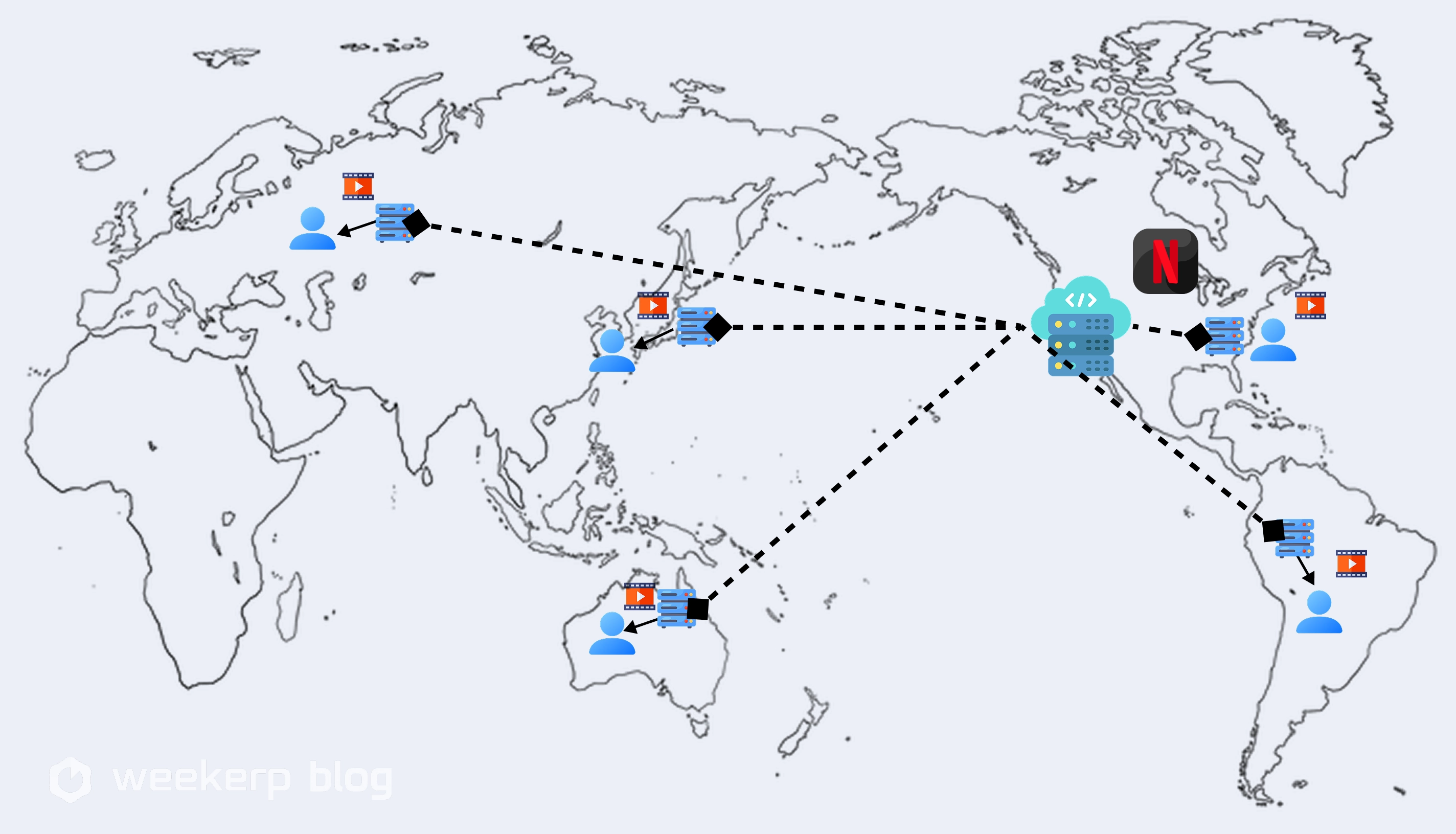
As MJ painfully discovered, Netflix has built “mini Netflix warehouses” filled with videos in major cities all around the world.
These warehouses are called POPs — Points of Presence.
When someone in Korea watches a show, the video doesn’t come from Netflix’s U.S. headquarters.
It’s delivered from a nearby POP right in Seoul.
In short, a CDN is a network that brings content closer to its users.
How does it work?
It’s actually simpler than you’d think.
Netflix copies its videos from the main server and stores them in CDN POPs all around the world — sort of like stocking shelves in local mini-warehouses.
This process of saving files ahead of time is called caching.
When someone hits play, the video or image is pulled from the nearest POP instead of a faraway origin server.
Because the data travels a much shorter distance, MJ can now enjoy Squid Game at the same speed whether he’s in Korea or the U.S.
Even startups use it now!
Back in the day, before public clouds existed, CDNs were something only giants like Disney or Yahoo could afford.
It was considered special infrastructure — powerful, but out of reach for most companies.
These days, it’s a completely different story.
CDNs have become so easy to use that even brand-new startups are adopting them from day one.
Out of curiosity, I looked into startups from Y Combinator, one of the biggest accelerators in the U.S.
Surprisingly, even companies that launched less than three months ago already have CDN integration about 98% of them, in fact.
It’s become a must-have technology, not a luxury.
Most startups today are building global from day one — and CDNs make that possible.
Curious what difference a CDN actually makes?
→ S3 vs CloudFront Speed Comparison
What are the benefits?
Using a CDN provides several key advantages:
-
Faster performance – Content is delivered from the nearest server, minimizing latency and improving load times.
-
Greater stability – Traffic is distributed across multiple edge servers, preventing overload during traffic spikes.
-
Stronger security – Edge servers absorb and filter malicious traffic, protecting the origin from DDoS and other attacks.
From an operator’s perspective, CDNs also bring:
-
SEO improvements, thanks to faster page delivery speeds.
-
Consistent global user experience, regardless of user location.
The modern approach: putting compute at the edge
Today, CDN providers are equipping their POPs with compute capabilities to handle a variety of processing tasks more efficiently.
For example, when watching Netflix on a PC versus on a mobile device, each requires different video formats and resolutions.
The same goes for images such as thumbnails — their sizes need to be adjusted based on the user’s device.
Traditionally, you could pre-store every possible size (50×50, 1000×1000, and so on).
But what if the CDN could process and resize the image on demand at the exact moment it’s requested — and then cache that processed version for later use?
This approach reduces storage usage, shortens development time, and delivers an optimized experience for every user.
This method is known as on-the-fly image processing.
The compute units attached to CDN POPs don’t just handle images — they also perform pre- and post-processing for web security (WAF), video, PDF, and other types of content.
This paradigm is what we call edge computing.
On public clouds
Public cloud providers offer their own CDN and edge computing services:
-
AWS — CloudFront + Lambda@Edge
-
Cloudflare — CDN + Workers
These platforms allow developers to attach custom logic or modules directly through code, enabling flexible edge-side processing.
In contrast, Weekerp provides a fully managed CDN with pre-built on-the-fly image processing and other edge capabilities — no coding required.
Common misconceptions
- I didn’t actually fly to the U.S.
- Netflix uses cloud infrastructure, so its servers aren’t located at its headquarters.
Summary
- A CDN delivers content from servers close to users, improving speed and performance.
-
POP (Points of Presence) store cached data for faster and more reliable delivery.
-
Edge computing enables real-time processing of images, videos, and other content.
-
For any global service, a CDN is no longer optional — it’s essential.
Meet Weekerp — your fully managed CDN solution.
Meet Weekerp — your fully managed CDN solution.
Go to Weekerp